Home » Books Cited » Big Bang
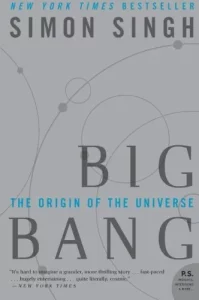
Big Bang
The Origin of the Universe
Big Bang: The most important scientific discovery of all time and why you need to know about it is a book written by Simon Singh and published in 2004 by Fourth Estate.

By Simon Singh
Simon Lehna Singh, is a British popular science author and theoretical and particle physicist. His written works include Fermat's Last Theorem, The Code Book, Big Bang, Trick or Treatment? Alternative Medicine on Trial and The Simpsons and Their Mathematical Secrets. In 2012 Singh founded the Good Thinking Society, through which he created the website "Parallel" to help students learn mathematics.
Excerpts
Of equal significance was the fact that everyone could see that the Moon itself was round, suggesting that the sphere was the natural state of being, adding even more ammunition to the round Earth hypothesis
Simon Singh
Big Bang: The Origin of the Universe
This architecture of scientific logic has an inherent beauty which emerges from how various arguments fit together, how several measurements interlock with one another, and how different theories are suddenly introduced to add strength to the edifice.
Simon Singh
Big Bang: The Origin of the Universe
Also, every myth represents the absolute truth within its society. The word ‘myth’ is derived from the Greek word mythos, which can mean ‘story’, but also means ‘word’, in the sense of ‘the final word’. Indeed, anybody who dared to question these explanations would have laid themselves open to accusations of heresy.
Simon Singh
Big Bang: The Origin of the Universe
Anaximander of Miletus argued that the Sun was a hole in a fire-filled ring that encircled the Earth and revolved around it. Similarly, he believed that the Moon and stars were nothing more than holes in the firmament, revealing otherwise hidden fires.
Simon Singh
Big Bang: The Origin of the Universe
Before any celestial distances or sizes could be calculated, the
ancient Greeks first had to establish that the Earth is a sphere. This view gained acceptance in ancient Greece as philosophers became familiar with the notion that ships gradually disappear over the horizon until only the tip of the mast could be seen. This made sense only if the surface of the sea curves and falls away. If the sea has a curved surface, then presumably so too does the Earth, which means it is probably a sphere.
Simon Singh
Big Bang: The Origin of the Universe
Egocentric attitudes may have been a contributory factor behind the dominance of the geocentric world-view, but there were other reasons for preferring an Earth-centred universe to Aristarchus’ Sun-centred universe.
One basic problem with the Sun-centred world-view was that it appeared to be simply ridiculous. It just seemed so utterly obvious that the Sun revolved round a static Earth, and not the other way round.
In short, a Sun-centred universe ran counter to common sense.
Simon Singh
Big Bang: The Origin of the Universe
First, the Greeks expected that if the Earth moved then we would feel a constant wind blowing against us, and we would be swept off our feet as the ground raced from under us. However, we feel no such constant wind, and neither is the ground tugged away, so the Greeks concluded that the Earth must be stationary.
Simon Singh
Big Bang: The Origin of the Universe
These loopy planetary orbits were hugely problematic for the ancient Greeks, because all the orbits were supposed to be circular according to Plato and his pupil Aristotle.
They declared that the circle, with its simplicity, beauty and lack of beginning or end, was the perfect shape, and since the heavens were the realm of perfection then celestial bodies had to travel in circles.
Simon Singh
Big Bang: The Origin of the Universe
It is the supreme challenge, and a brutal one, but every scientific theory must be testable and compatible with reality. The nineteenth-century naturalist Thomas Huxley stated it thus:
‘The great tragedy of Science — the slaying of a beautiful hypothesis by an ugly fact.’
Simon Singh
Big Bang: The Origin of the Universe
The word ‘cosmology’ is derived from the ancient Greek word kosmeo, which means ‘to order’ or ‘to organise’, reflecting the belief that the universe could be understood and is worthy of analytical study. The cosmos had patterns, and it was the ambition of the Greeks to recognise these patterns, to scrutinise them and to understand what was behind them.
Simon Singh
Big Bang: The Origin of the Universe
This is not to say that the new wave of philosophers necessarily wanted to deny the existence of the gods, rather that they merely refused to believe that it was divine meddling that was responsible for natural phenomena.
Simon Singh
Big Bang: The Origin of the Universe